Seven Savers for Earth Day
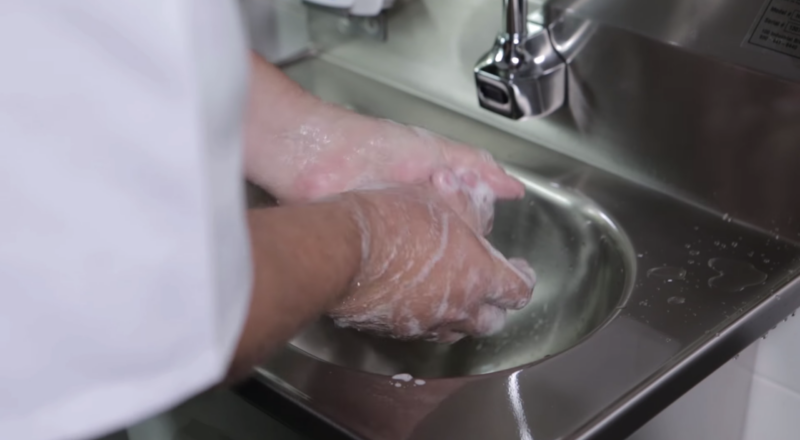
Wash your hands. That’s our simple summary to celebrate Earth Day.
Poor hand hygiene is likely the single largest contributing factor to diarrhea in North America. If we want to talk about waste, let's start with diarrhea's dire damper on productivity and resource losses starting with water and toilet paper. One missed handwash can ignite a chain of illness throughout the workplace, schools, guests, patients and family.
We do know that norovirus is by far the dominant pathogen causing foodborne outbreaks, like those endured by cruise ships, schools and nursing homes. Its primary path of destruction is confirmed by the CDC to be fecal-hand-oral. We are feasting on invisible germs, in this case, virus, picked up from others via casual contact with an ill person. This contact may be via food prepared by an ill worker. The source is often a person who shows no symptoms or from a surface which shows no symptoms - it's clean to the FDA accepted standard of "clean to sight and touch". Norovirus can live for days or even weeks and remains invisible and free of odor for the whole time. (See Dr. Christine Moe's work at Emory University.)
Here are our Earth Day recommendations focused on our daily lives away from home: Read more about Seven Savers for Earth Day
Mock Trial Vividly Portrays Consequences of Lax Food Handling
John Ciarametaro experienced his own ‘Perry Mason moment’ recently. It happened when Legal Seafood’s manager of Lab and Inspectional Services served as a juror during a mock trial of typical food safety litigation.


“I attended the annual National Environmental Health Association conference in Atlantic City (NJ),” he explained, “which fulfills the continuing education units necessary to maintain my REHS/RS certification.” The conference is attended by virtually all branches of public health professionals, and includes the usual array of lectures, workshops, seminar, and technical presentations.”
“But this mock trial was a pretty cool way of dramatizing and bringing to life the realities of failures in the food safety system,” he said. “Along with Ellen Schroth (Legal’s food safety and sanitation auditing consultant for the Mid-Atlantic region), I spent an afternoon playing one member of a jury pool. We listened to final arguments, presented by real lawyers, using real facts drawn from common cases.” The prosecutor and defense attorney were played by lawyers from MarlerClark which is the high-profile firm best known for handling foodborne illness cases, especially the notorious Jack-in-the-Box contaminated meat frenzy in the 1990s. The ‘judge’ for the mock trial was portrayed by a lawyer from the host hotel, the Tropicana.
Read more about Mock Trial Vividly Portrays Consequences of Lax Food HandlingHow to Set, Train and Sustain Handwashing Quality
Without a specification for the Read more about How to Set, Train and Sustain Handwashing Quality
Does the use of a Food Code compliant alcohol hand sanitizer replace a handwash or a non-handwash?
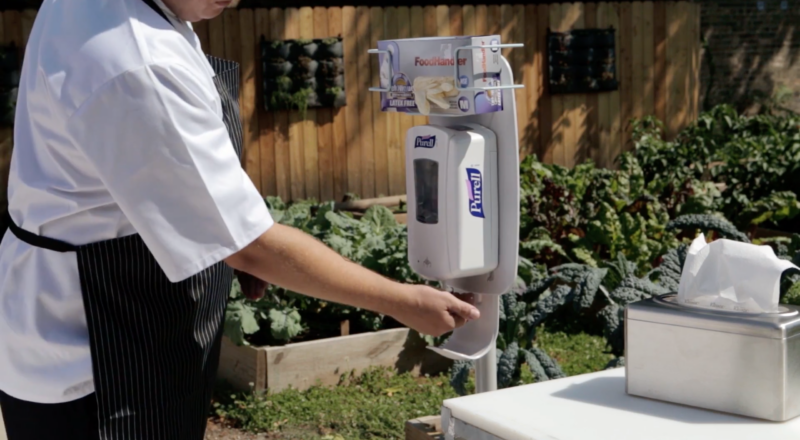
Does installing auxiliary No-water Handwashing Stations make sense for some locations?
In this practice an alcohol based hand sanitizer dispenser is installed alongside a paper towel dispenser and a waste container. Read more about Does installing auxiliary No-water Handwashing Stations make sense for some locations?
How to calculate the ROI for a hep A vaccination program amongst foodservice workers.
Vaccination of the foodservice workforce eliminates only 1% of Read more about How to calculate the ROI for a hep A vaccination program amongst foodservice workers.
Nailbrush: Food Safety's Friend or Foe?
Fecal-hand-oral is the most frequent pathway for the #1 cause of Read more about Nailbrush: Food Safety's Friend or Foe?
How to keep foodservice surfaces hygienic. Cleaner surfaces result in cleaner hands.
Surface cleaning and sanitizing are high frequency t Read more about How to keep foodservice surfaces hygienic. Cleaner surfaces result in cleaner hands.
Water Temperature: Comfort drives compliance.
Today's quality handsoaps are like the "cold water" laundry products. They are very effective at low wash temperatures, thus protecting our epidermal fabric, the skin. Read more about Water Temperature: Comfort drives compliance.