Regional Websites: North America
South Africa
United Kingdom ![]()
2005 Food Code - Hand Hygiene Version
Intent
1-102.10 Food Safety, Illness Prevention, and Honest Presentation.
The purpose of this Code is to safeguard public health and provide to consumers food that is safe, unadulterated, and honestly presented.
Scope
1-103.10 Statement.
This Code establishes definitions; sets standards for management and personnel, food operations, and equipment and facilities; and provides for food establishment plan review, permit issuance, inspection, employee restriction, and permit suspension.
Responsibility
2-101.11 Assignment.*
The permit holder shall be the person in charge or shall designate a person in charge and shall ensure that a person in charge is present at the food establishment during all hours of operation.
Knowledge
2-102.11 Demonstration.*
Based on the risks inherent to the food operation, during inspections and upon request the person in charge shall demonstrate to the Regulatory authority knowledge of foodborne disease prevention, application of the Hazard Analysis and Critical Control Point principles, and the requirements of this Code. The person in charge shall demonstrate this knowledge by:
(A) Complying with this Code by having no violations of critical items during the current inspection;
(B) Being a certified food protection manager who has shown proficiency of required information through passing a test that is part of an accredited program; or
(C) Responding correctly to the inspector's questions as they relate to the specific food operation. The areas of knowledge include:
(1) Describing the relationship between the prevention of foodborne disease and the personal hygiene of a food employee;
(2) Explaining the responsibility of the person in charge for preventing the transmission of foodborne disease by a food employee who has a disease or medical condition that may cause foodborne disease;
(3) Describing the symptoms associated with the diseases that are transmissible through food;
(8) Describing the relationship between the prevention of foodborne illness and the management and control of the following:
(a) Cross contamination,
(b) Hand contact with ready-to-eat foods,
(c) Handwashing, and
(d) Maintaining the food establishment in a clean condition and in good repair;
(10) Explaining the relationship between food safety and providing equipment that is:
(a) Sufficient in number and capacity, and
(b) Properly designed, constructed, located, installed, operated, maintained, and cleaned;
(11) Explaining correct procedures for cleaning and sanitizing utensils and food-contact surfaces of equipment;
(14) Identifying critical control points in the operation from purchasing through sale or service that when not controlled may contribute to the transmission of foodborne illness and explaining steps taken to ensure that the points are controlled in accordance with the requirements of this Code;
(15) Explaining the details of how the person in charge and food employees comply with the HACCP plan if a plan is required by the law, this Code, or an agreement between the Regulatory authority and the establishment;
(16) Explaining the responsibilities, rights, and authorities assigned by this Code to the:
(a) food employee,
(b) conditional employee,
(c) person in charge,
(d) Regulatory authority; and
(17) Explaining how the person in charge, food employees, and conditional employees comply with reporting responsibilities and exclusion or restriction of food employees.
2-102.20 Food Protection Manager Certification.
A person in charge who demonstrates knowledge by being a food protection manager that is certified by a food protection manager certification program that is evaluated and listed by a Conference for Food Protection-recognized accrediting agency as conforming to the Conference for Food Protection Standards for Accreditation of Food Protection Manager Certification Programs is deemed to comply with ¶ 2-102.11(B).
Duties
2-103.11 Person in Charge.
The person in charge shall ensure that:
(D) Employees are effectively cleaning their hands, by routinely monitoring the Employees' handwashing;
(K) Except when approval is obtained from the Regulatory authority as specified in ¶ 3-301.11(D), Employees are preventing cross-contamination of ready-to-eat food with bare hands by properly using suitable utensils such as deli tissue, spatulas, tongs, single-use gloves, or dispensing equipment; and
(L) Employees are properly trained in food safety as it relates to their assigned duties.
(M) Food employees and conditional employees are informed of their responsibility to report in accordance with law, to the person in charge, information about their health and activities as they relate to diseases that are transmissible through food, as specified under ¶ 2-201.11(a).
Responsibilities and Reporting Symptoms and Diagnosis
2-201.11 Responsibility of Permit Holder, Person in Charge, and Conditional Employees.*
(A) The permit holder shall require food employees and conditional employees to report to the person in charge, information about their health and activities as they relate to diseases that are transmissible through food. A food employee or conditional employee shall report the information in a manner that allows the person in charge to reduce the risk of foodborne disease transmission, including providing necessary additional information, such as the date of onset of symptoms and an illness, or of a diagnosis without symptoms, if the food employee or conditional employee:
reportable symptoms
(1) Has any of the following symptoms:
(a) Vomiting,
(b) Diarrhea,
(c) Jaundice,
(d) Sore throat with fever, or
(e) A lesion containing pus such as a boil or infected wound that is open or draining and is:
(i) On the hands or wrists, unless an impermeable cover such as a finger cot or stall protects the lesion and a single-use glove is worn over the impermeable cover,
(ii) On exposed portions of the arms, unless the lesion is protected by an impermeable cover, or
(iii) On other parts of the body, unless the lesion is covered by a dry, durable, tight-fitting bandage;
reportable diagnosis
(2) Has an illness diagnosed by a health practitioner due to:
(a) Norovirus,
(b) Hepatitis A virus,
(c) Shigella spp.,
(d) Enterohemorrhagic or shiga toxin-producing Escherichia coli, or
(e) Salmonella Typhi;
reportable past illness
(3) Had a previous illness, diagnosed by a health practitioner, within the past 3 months due to Salmonella Typhi, without having received antibiotic therapy, as determined by a health practitioner;
reportable history of exposure
(4) Has been exposed to, or is the suspected source of, a confirmed disease outbreak, because the food employee or conditional employee consumed or prepared food implicated in the outbreak, or consumed food at an event prepared by a person who is infected or ill with:
(a) Norovirus within the past 48 hours of the last exposure,
(b) Enterohemorrhagic or shiga toxin-producing escherichia coli, or Shigella spp. within the past 3 days of
the last exposure,
(c) Salmonella Typhi within the past 14 days of the last exposure, or
(d) Hepatitis A virus within the past 30 days of the last exposure; or
reportable history of exposure
(5) Has been exposed by attending or working in a setting where there is a confirmed disease outbreak, or living in the same household as, and has knowledge about, an individual who works or attends a setting where there is a confirmed disease outbreak, or living in the same household as, and has knowledge about, an individual diagnosed with an illness caused by:
(a) Norovirus within the past 48 hours of the last exposure,
(b) Enterohemorrhagic or shiga toxin-producing escherichia coli, or Shigella spp. within the past 3 days of
the last exposure,
(c) Salmonella Typhi within the past 14 days of the last exposure, or
(d) Hepatitis A virus within the past 30 days of the last exposure.
responsibility of person in charge to notify the regulatory authority
(B) The person in charge shall notify the regulatory authority when a food employee is:
(1) Jaundiced, or
(2) Diagnosed with an illness due to a pathogen as specified under Subparagraphs (A)(2)(a) - (e) of this section.
responsibility of the person in charge to prohibit a conditional employee from becoming a food employee
(C) The person in charge shall ensure that a conditional employee:
(1) Who exhibits or reports a symptom, or who reports a diagnosed illness as specified under Subparagraphs (A)(1) - (3) of this section, is prohibited from becoming a food employee until the conditional employee meets the criteria for the specific symptoms or diagnosed illness as specified under § 2-201.13; and
(2) Who will work as a food employee in a food establishment that serves as a highly susceptible
population and reports a history of exposure as specified under Subparagraphs (A)(4) – (5), is prohibited from becoming a food employee until the conditional employee meets the criteria as specified under ¶ 2-201.13(I).
responsibility of the person in charge to exclude or restrict
(D) The person in charge shall ensure that a food employee who exhibits or reports a symptom, or who reports a diagnosed illness or a history of exposure as specified under Subparagraphs (A)(1) - (5) of this section is:
(1) Excluded as specified under ¶¶ 2-201.12 (A) - (C), and Subparagraphs (D)(1), (E)(1), (F)(1), or (G)(1) and in compliance with the provisions specified under ¶¶ 2-201.13(A) - (G); or
(2) Restricted as specified under Subparagraphs 2-201.12 (D)(2), (E)(2), (F)(2), (G)(2), or ¶¶ 2-201.12(H) or (I) and in compliance with the provisions specified under ¶¶ 2-201.13(D) - (I).
responsibility of food employees and conditional employees to report
(E) A food employee or conditional employee shall report to the
person in charge the information as specified under ¶ (A) of this
section.
responsibility of food employees to comply
(F) A food employee shall:
(1) Comply with an exclusion as specified under
¶¶ 2-201.12(A) - (C) and Subparagraphs 2-201.12(D)(1),
(E)(1), (F)(1), or (G)(1) and with the provisions specified under ¶¶ 2-201.13(A) - (G); or
(2) Comply with a restriction as specified under
Subparagraphs 2-201.12(D)(2), (E)(2), (F)(2), (G)(2), or
¶¶ 2-201.12 (H) or (I) and comply with the provisions specified under ¶¶ 2-201.13(D) - (I).
conditions of exclusion and restriction
2-201.12 Exclusions and Restrictions.*
The person in charge shall exclude or restrict a food employee from a food establishment in accordance with the following:
symptomatic with vomiting or diarrhea
(A) Except when the symptom is from a noninfectious condition, exclude a food employee if the food employee is:
(1) Symptomatic with vomiting or diarrhea; or
(2) Symptomatic with vomiting or diarrhea and diagnosed with an infection from Norovirus, Shigella spp., or Enterohemorrhagic or Shiga toxin-producing E. coli.
jaundiced or diagnosed with hepatitis A infection
(B) Exclude a food employee who is:
(1) Jaundiced and the onset of jaundice occurred within the last 7 calendar days, unless the food employee provides to the person in charge written medical documentation from a health practitioner specifying that the jaundice is not caused by hepatitis A virus or other fecal-orally transmitted infection;
(2) Diagnosed with an infection from hepatitis A virus within 14 calendar days from the onset of any illness symptoms, or within 7 calendar days of the onset of jaundice; or
(3) Diagnosed with an infection from hepatitis A virus without developing symptoms.
diagnosed or reported previous infection due to S. Typhi
(C) Exclude a food employee who is diagnosed with an infection from Salmonella Typhi, or reports a previous infection with Salmonella Typhi within the past 3 months as specified under Subparagraph 2-201.11(A)(3).
diagnosed with an asymptomatic infection from Norovirus
(D) If a food employee is diagnosed with an infection from Norovirus and is asymptomatic:
(1) Exclude the food employee who works in a food establishment serving a highly susceptible population; or
(2) Restrict the food employee who works in a food establishment not serving a highly susceptible population.
diagnosed with Shigella spp. Infection and asymptomatic
(E) If a food employee is diagnosed with an infection from Shigella spp. and is asymptomatic:
(1) Exclude the food employee who works in a food establishment serving a highly susceptible population; or
(2) Restrict the food employee who works in a food establishment not serving a highly susceptible population.
diagnosed with EHEC or STEC and asymptomatic
(F) If a food employee is diagnosed with an infection from Enterohemorrhagic or Shiga toxin-producing E. coli, and is asymptomatic:
(1) Exclude the food employee who works in a food establishment serving a highly susceptible population; or
(2) Restrict the food employee who works in a food establishment not serving a highly susceptible population.
symptomatic with sore throat with fever
(G) If a food employee is ill with symptoms of acute onset of sore throat with fever:
(1) Exclude the food employee who works in a food establishment serving a highly susceptible population; or
(2) Restrict the food employee who works in a food establishment not serving a highly susceptible population.
symptomatic with uncovered infected wound or pustular boil
(H) If a food employee is infected with a skin lesion containing pus such as a boil or infected wound that is open or draining and not properly covered as specified under Subparagraph 2-201.11(A)(1)(e), restrict the food employee.
exposed to foodborne pathogen and works in food establishment serving HSP
(I) If a food employee is exposed to a foodborne pathogen as specified under Subparagraphs 2-201.11(A)(4) or (5), restrict the food employee who works in a food establishment serving a highly susceptible population.
Managing Exclusions and Restrictions
2-201.13 Removal, Adjustment, or Retention of Exclusions and Restrictions.
The person in charge may remove, adjust, or retain the exclusion or restriction of a food employee according to the following conditions:
(A) Except when a food employee is diagnosed with an infection from hepatitis A virus or Salmonella Typhi:
removing exclusion for food employee who was symptomatic and not diagnosed
(1) Reinstate a food employee who was excluded as specified under Subparagraph 2-201.12(A)(1) if the food employee:
(a) Is asymptomatic for at least 24 hours; or
(b) Provides to the person in charge written medical documentation from a health practitioner that states the symptom is from a noninfectious condition.
Norovirus diagnosis adjusting exclusion for food employee who was symptomatic and is now asymptomatic
(2) If a food employee was diagnosed with an infection from Norovirus and excluded as specified under Subparagraph 2-201.12(A)(2):
(a) restrict the food employee, who is asymptomatic for at least 24 hours and works in a food establishment not serving a highly susceptible population, until the conditions for reinstatement as specified under Subparagraphs (D)(1) or (2) of this section are met; or
retaining exclusion for food employee who was asymptomatic and is now asymptomatic and works in food establishment serving HSP
(b) Retain the exclusion for the food employee, who is asymptomatic for at least 24 hours and works in a food establishment that serves a highly susceptible population, until the conditions for reinstatement as specified under Subparagraphs (D)(1) or (2) of this section are met.
Shigella spp. Diagnosis adjusting exclusion for food employee who was symptomatic and is now symptomatic
(3) If a food employee was diagnosed with an infection from Shigella spp. and excluded as specified under Subparagraph 2-201.12(A)(2):
(a) restrict the food employee, who is asymptomatic for at least 24 hours and works in a food establishment not serving a highly susceptible population, until the conditions for reinstatement as specified under Subparagraphs (E)(1) or (2) of this section are met; or
retaining exclusion for food employee who was asymptomatic and is now asymptomatic
(b) Retain the exclusion for the food employee, who is asymptomatic for at least 24 hours and works in a food establishment that serves a highly susceptible population, until the conditions for reinstatement as specified under Subparagraphs (E)(1) or (2) , or (E)(1) and (3)(a) of this section are met.
EHEC or STEC diagnosis
(4) If a food employee was diagnosed with an infection from Enterohemorrhagic or Shiga toxin-producing Escherichia coli and excluded as specified under Subparagraph 2-201.12(A)(2):
adjusting exclusion for food employee who was symptomatic and is now asymptomatic
(a) Restrict the food employee, who is asymptomatic for at least 24 hours and works in a food establishment not serving a highly susceptible population, until the conditions for reinstatement as specified under Subparagraphs (F)(1) or (2) of this section are met; or
retaining exclusion for food employee who was symptomatic and is now asymptomatic and works in food establishment serving HSP
(b) Retain the exclusion for the food employee, who is asymptomatic for at least 24 hours and works in a food establishment that serves a highly susceptible population, until the conditions for reinstatement as specified under Subparagraphs (F)(1) or (2) are met.
hepatitis A virus or jaundice diagnosis - removing exclusions
(B) Reinstate a food employee who was excluded as specified under ¶ 2-201.12(B) if the person in charge obtains approval from the Regulatory authority and one of the following conditions is met;
(1) The food employee has been jaundiced for more than 7 calendar days;
(2) The anicteric food employee has been symptomatic with symptoms other than jaundice for more than 14 calendar days; or
(3) the food employee provides to the person in charge written medical documentation from a health practitioner stating that the food employee is free of a hepatitis A virus infection.
S. Typhi diagnosis - removing exclusions
(C) Reinstate a food employee who was excluded as specified under ¶ 2-201.12(C) if:
(1) The person in charge obtains approval from the Regulatory authority; and
(2) The food employee provides to the person in charge written medical documentation from a health practitioner that states the food employee is free from S. Typhi infection.
Norovirus diagnosis - removing exclusion or restriction
(D) Reinstate a food employee who was excluded as specified under Subparagraphs 2-201.12(A)(2) or (D)(1) who was restricted under Subparagraph 2-201.12(D)(2) if the person in charge obtains approval from the Regulatory authority and one of the following conditions is met:
(1) The excluded or restricted food employee provides to the person in charge written medical documentation from a health practitioner stating that the food employee is free of a Norovirus infection;
(2) The food employee was excluded or restricted after symptoms of vomiting or diarrhea resolved, and more than 48 hours have passed since the food employee became asymptomatic; or
(3) The food employee was excluded or restricted and did not develop symptoms and more than 48 hours have passed since the food employee was diagnosed.
Shigella spp. diagnosis - removing exclusion or restriction
(E) Reinstate a food employee who was excluded as specified under Subparagraphs 2-201.12(A)(2) or (E)(1) or who was restricted under Subparagraph 2-201.12(E)(2) if the person in charge obtains approval from the Regulatory authority and one of the following conditions is met:
(1) The excluded or restricted food employee provides to the person in charge written medical documentation from a health practitioner stating that the food employee is free of a Shigella spp. infection based on test results showing 2 consecutive negative stool specimen cultures that are taken:
(a) Not earlier than 48 hours after discontinuance of antibiotics, and
(b) At least 24 hours apart;
(2) The food employee was excluded or restricted after symptoms of vomiting or diarrhea resolved, and more than 7 calendar days have passed since the food employee
became asymptomatic; or
(3) The food employee was excluded or restricted and did not develop symptoms and more than 7 calendar days have passed since the food employee was diagnosed.
EHEC or STEC diagnosis – removing exclusion or restriction
(F) Reinstate a food employee who was excluded or restricted as specified under Subparagraphs 2-201.12(A)(2) or (F)(1) or who was restricted under Subparagraph 2-201.12(F)(2) if the person in charge obtains approval from the Regulatory authority and one of the following conditions is met:
(1) The excluded or restricted food employee provides to the person in charge written medical documentation from a health practitioner stating that the food employee is free of an infection from Enterohemorrhagic or Shiga toxin-producing Escherichia coli based on test results that show 2 consecutive negative stool specimen cultures that are taken:
(a) Not earlier than 48 hours after discontinuance of antibiotics; and
(b) At least 24 hours apart;
(2) The food employee was excluded or restricted after symptoms of vomiting or diarrhea resolved and more than 7 calendar days have passed since the food employee became asymptomatic; or
(3) The food employee was excluded or restricted and did not develop symptoms and more than 7 days have passed since the food employee was diagnosed.
sore throat with fever - removing exclusion or restriction
(G) Reinstate a food employee who was excluded or restricted as specified under Subparagraphs 2-201.12(G)(1) or (2) if the food employee provides to the person in charge written medical documentation from a health practitioner stating that the food employee meets one of the following conditions:
(1) Has received antibiotic therapy for Streptococcus pyogenes infection for more than 24 hours;
(2) Has at least one negative throat specimen culture for Streptococcus pyogenes infection; or
(3) Is otherwise determined by a health practitioner to be free of a Streptococcus pyogenes infection.
uncovered infected wound or pustular boil - removing restriction
(H) Reinstate a food employee who was restricted as specified under ¶ 2-201.12(H) if the skin, infected wound, cut, or pustular boil is properly covered with one of the following:
(1) An impermeable cover such as a finger cot or stall and a single-use glove over the impermeable cover if the infected wound or pustular boil is on the hand, finger, or wrist;
(2) An impermeable cover on the arm if the infected wound or pustular boil is on the arm; or
(3) A dry, durable, tight-fitting bandage if the infected wound or pustular boil is on another part of the body.
exposure to foodborne pathogen and works in food establishment serving HSP – removing restriction
(I) Reinstate a food employee who was restricted as specified under ¶ 2-201.12(I) and was exposed to one of the following pathogens as specified under Subparagraph 2-201.11(A)(4) or (5):
Norovirus
(1) Norovirus and one of the following conditions is met:
(a) More than 48 hours have passed since the last day the food employee was potentially exposed; or
(b) More than 48 hours have passed since the food employee’s household contact became asymptomatic.
Shigella spp., EHEC,or STEC
(2) Shigella spp. or Enterohemorrhagic or Shiga toxin-producing Escherichia coli and one of the following conditions is met:
(a) More than 3 calendar days have passed since the last day the food employee was potentially exposed; or
(b) More than 3 calendar days have passed since the food employee’s household contact became asymptomatic.
S. Typhi
(3) S. Typhi and one of the following conditions is met:
(a) More than 14 calendar days have passed since the last day the food employee was potentially exposed; or
(b) More than 14 calendar days have passed since the food employee’s household contact became asymptomatic.
hepatitis A
(4) Hepatitis A virus and one of the following conditions is met:
(a) The food employee is immune to hepatitis A virus infection because of a prior illness from hepatitis A;
(b) The food employee is immune to hepatitis A virus infection because of vaccination against hepatitis A;
(c) The food employee is immune to hepatitis A virus infection because of IgG administration;
(d) More than 30 calendar days have passed since the last day the food employee was potentially exposed;
(e) More than 30 calendar days have passed since the food employee’s household contact became jaundiced; or
(f) The food employee does not use an alternative procedure that allows bare hand contact with ready-to-eat food until at least 30 days after the potential exposure, as specified in Subparagraphs (I)(4)(d) and (e) of this section, and the food employee receives additional training about:
(i) Hepatitis A symptoms and preventing the transmission of infection,
(ii) Proper handwashing procedures, and
(iii) Protecting ready-to-eat food from contamination introduced by bare hand contact.
Hands and Arms
2-301.11 Clean Condition.*
Food Employees shall keep their hands and exposed portions of their arms clean.
2-301.12 Cleaning Procedure.*
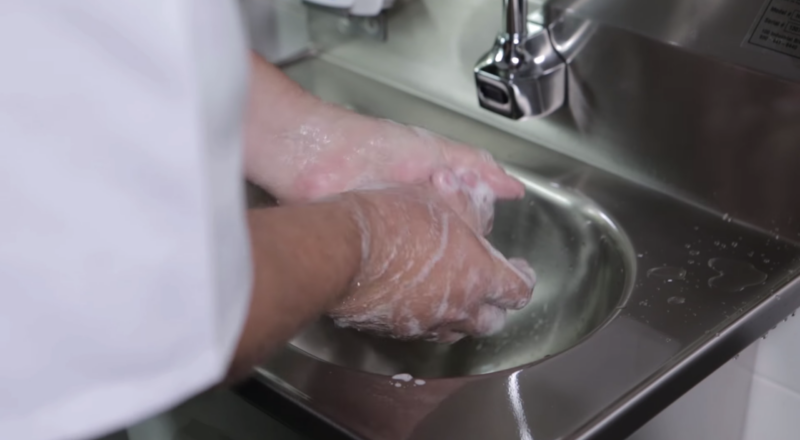
(A) Except as specified in ¶ (D) of this section, food employees shall clean their hands and exposed portions of their arms including surrogate prosthetic devices for hands or arms for at least 20 seconds, using a cleaning compound in a handwashing sink that is equipped as specified under § 5-202.12 and Subpart 6-301.
(B) Food employees shall use the following cleaning procedure in the order stated to clean their hands and exposed portions of their arms, including surrogate prosthetic devices for hands and arms:
(1) Rinse under clean, running warm water;
(2) Apply an amount of cleaning compound recommended by t he cleaning compound manufacturer;
(3) Rub together vigorously for at least 10 to 15 seconds while:
(a) Paying particular attention to removing soil from underneath the fingernails during the cleaning procedure, a nd
(b) Creating friction on the surfaces of the hands and arms or surrogate prosthetic devices for hands and arms, finger tips, and areas between the fingers;
(4) Thoroughly rinse under clean, running warm water; and
(5) Immediately follow the cleaning procedure with thorough drying using a method as specified under § 6-301.12.
(C) To avoid recontaminating their hands or surrogate prosthetic devices, food employees may use disposable paper towels or similar clean barriers when touching surfaces such as manually operated faucet handles on a handwashing sink or the handle of a restroom door.
(D) If approved and capable of removing the types of soils encountered in the food operations involved, an automatic handwashing facility may be used by food employees to clean their hands or surrogate prosthetic devices.
2-301.13 Special Handwash Procedures.*
Reserved.
2-301.14 When to Wash.*
Food Employees shall clean their hands and exposed portions of their arms as specified under § 2-301.12 immediately before engaging in food preparation including working with exposed food, clean equipment and utensils, and unwrapped single-service and single-use articles and:
(A) After touching bare human body parts other than clean hands and clean, exposed portions of arms;
(B) After using the toilet room;
(C) After caring for or handling service animals or aquatic animals as specified in ¶ 2-403.11(B);
(D) Except as specified in ¶ 2-401.11(B), after coughing, sneezing, using a handkerchief or disposable tissue, using tobacco, eating, or drinking;
(E) After handling soiled equipment or utensils;
(F) During food preparation, as often as necessary to remove soil and contamination and to prevent cross contamination when changing tasks;
(G) When switching between working with raw food and working with ready-to-eat food;
(H) Before donning gloves for working with food; and
(I) After engaging in other activities that contaminate the hands.
2-301.15 Where to Wash.
Food Employees shall clean their hands in a handwashing sink or approved automatic hand washing facility and may not clean their hands in a sink used for food preparation or warewashing, or in a service sink or a curbed cleaning facility used for the disposal of mop water and similar liquid waste.
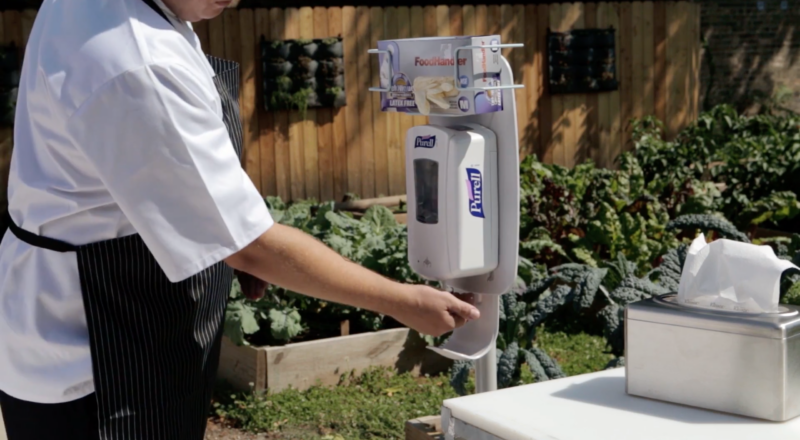
2-301.16 Hand Anitseptics.
(A) A hand antiseptic used as a topical application, a hand antiseptic solution used as a hand dip, or a hand antiseptic soap shall:
(1) Comply with one of the following:
(a) Be an approved drug that is listed in the FDA publication Approved Drug Products with Therapeutic Equivalence Evaluations as an approved drug based on safety and effectiveness; or
(b) Have active antimicrobial ingredients that are listed in the FDA monograph for OTC Health-Care Antiseptic Drug Products as an antiseptic handwash, and
(2) Comply with one of the following:
(a) Have components that are exempted from the requirement of being listed in federal food additive regulations as specified in 21 CFR 170.39 - Threshold of regulation for substances used in food-contact articles; or
(b) Comply with and be listed in:
(i) 21 CFR 178 - Indirect Food additives:Adjuvants, Production Aids, and Sanitizers as regulated for use as a food additive with conditions of safe use, or
(ii) 21 CFR 182 - Substances Generally Recognized as Safe, 21 CFR 184 - Direct Food Substances Affirmed as Generally Recognized as Safe, or 21 CFR 186 - Indirect Food Substances Affirmed as Generally Recognized as Safe for use in contact with food; and
(3) Be applied only to hands that are cleaned as specified under § 2-301.12.
(B) If a hand antiseptic or a hand antiseptic solution used as a hand dip does not meet the criteria specified under Subparagraph (A)(2) of this section, use shall be:
(1) Followed by thorough hand rinsing in clean water before hand contact with food or by the use of gloves; or
(2) Limited to situations that involve no direct contact with food by the bare hands.
(C) A hand antiseptic solution used as a hand dip shall be maintained clean and at a strength equivalent to at least 100 mg/L chlorine.
Fingernails
2-302.11 Maintenance.
(A) Food employees shall keep their fingernails trimmed, filed, and maintained so the edges and surfaces are cleanable and not rough.
(B) Unless wearing intact gloves in good repair , a food employee may not wear fingernail polish or artificial fingernails when working with exposed food.
Jewelry
2-303.11 Prohibition.
Except for a plain ring such as a wedding band, while preparing food, food employees may not wear jewelry including medical information jewelry on their arms and hands.
Food Contamination Prevention
2-401.11 Eating, Drinking, or Using Tobacco.*
(A) Except as specified in ¶ (B) of this section, an employee shall eat, drink, or use any form of tobacco only in designated areas where the contamination of exposed food; clean equipment, utensils, and linens; unwrapped single-service and single-use articles; or other items needing protection can not result.
(B) A food employee may drink from a closed beverage container if the container is handled to prevent contamination of:
(1) The employee's hands;
(2) The container; and
(3) Exposed food; clean equipment , utensils , and linens ; and unwrapped single-service and single-use articles .
2-401.12 Discharges from the Eyes, Nose, and Mouth.*
Food employees experiencing persistent sneezing, coughing, or a runny nose that causes discharges from the eyes, nose, or mouth may not work with exposed food; clean equipment, utensils, and linens; or unwrapped single-service or single-use articles.
Condition
3-101.11 Safe, Unadulterated, and Honestly Presented.*
Food shall be safe, unadulterated, and, as specified under § 3-601.12, honestly presented.
Preventing Contamination by Employees
3-301.11 Preventing Contamination from Hands.*
(A) Food employees shall wash their hands as specified under § 2-301.12.
(B) Except when washing fruits and vegetables as specified under § 3-302.15 or as specified in ¶ (D) of this section, food employees may not contact exposed, ready-to-eat food with their bare hands and shall use suitable utensils such as deli tissue, spatulas, tongs, single-use gloves, or dispensing equipment.
(C) Food employees shall minimize bare hand and arm contact with exposed food that is not in a ready-to-eat form. S
(D) Food employees not serving a highly susceptible population may contact exposed, ready-to-eat food with their bare hands if:
(1) The permit holder obtains prior approval from the Regulatory authority;
(2) Written procedures are maintained in the food establishment and made available to the regulatory authority upon request that include:
(a) For each bare hand contact procedure, a listing of the specific ready-to-eat foods that are touched by bare hands,
(b) Diagrams and other information showing that handwashing facilities, installed, located, equipped, and maintained as specified under §§ 5-203.11, 5-204.11, 5-205.11, 6-301.11, 6-301.12, and 6-301.14, are in an easily accessible location and in close proximity to the work station where the bare hand contact procedure is conducted;
(3) A written employee health policy that details how the food establishment complies with §§ 2-201.11, 2-201.12, and 2-201.13 including:
(a) Documentation that food employees and conditional employees acknowledge that they are informed to report information about their health and activities as they relate to gastrointestinal symptoms and diseases that are transmittable through Food as specified under ¶ 2-201.11(A),
(b) Documentation that food employees and conditional employees acknowledge their responsibilities as specified under ¶ 2-201.11(E) and (F), and
(c) Documentation that the person in charge acknowledges the responsibilities as specified under ¶¶ 2-201.11(B), (C) and (D), and §§ 2-201.12 and 2-201.13;
(4) Documentation that food employees acknowledge that they have received training in:
(a) The risks of contacting the specific ready-to-eat foods with bare hands,
(b) Proper handwashing as specified under § 2-301.12,
(c) When to wash their hands as specified under § 2-301.14,
(d) Where to wash their hands as specified under § 2-301.15,
(e) Proper fingernail maintenance as specified under § 2-302.11,
(f) Prohibition of jewelry as specified under § 2-303.11, and
(g) Good hygienic practices as specified under §§2-401.11 and 2-401.12;
(5) Documentation that hands are washed before food preparation and as necessary to prevent cross contamination by food employees as specified under §§ 2-301.11, 2-301.12, 2-301.14, and 2-301.15 during all hours of operation when the specific ready-to-eat foods are prepared;
(6) Documentation that food employees contacting ready-to-eat food with bare hands use two or more of the following control measures to provide additional safeguards to hazards associated with bare hand contact:
(a) Double handwashing,
(b) Nail brushes,
(c) A hand antiseptic after handwashing as specified under § 2-301.16,
(d) Incentive programs such as paid sick leave that assist or encourage food employees not to work when they are ill, or
(e) Other control measures approved by the Regulatory authority; and
(7) Documentation that corrective action is taken when Subparagraphs (D)(1) - (6) of this section are not followed.
3-304.15 Gloves, Use Limitation.
(A) If used, single-use gloves shall be used for only one task such as working with ready-to-eat food or with raw animal food, used for no other purpose, and discarded when damaged or soiled, or when interruptions occur in the operation.
Disposition
3-701.11 Discarding or Reconditioning Unsafe, Adulterated, or Contaminated Food.*
(D) Food that is contaminated by food employees, consumers, or other persons through contact with their hands, bodily discharges, such as nasal or oral discharges, or other means shall be discarded.
Water Quantity and Availability
5-103.11 Capacity.*
(A) The water source and system shall be of sufficient capacity to meet the peak water demands of the food establishment.
(B) Hot water generation and distribution systems shall be sufficient to meet the peak hot water demands throughout the food establishment.
Design, Construction, and Installation
5-202.11 Approved System and Cleanable Fixtures.*
(A) A plumbing system shall be designed, constructed, and installed according to law.
(B) A plumbing fixture such as a handwashing sink, toilet, or urinal shall be easily cleanable. N
5-202.12 Handwashing Sink, Installation.
(A) A handwashing sink shall be equipped to provide water at a temperature of at least 38°C (100°F) through a mixing valve or combination faucet.
(B) A steam mixing valve may not be used at a handwashing sink.
(C) A self-closing, slow-closing, or metering faucet shall provide a flow of water for at least 15 seconds without the need to reactivate the faucet.
(D) An automatic handwashing facility shall be installed in accordance with manufacturer's instructions.
Numbers and Capacities
5-203.11 Handwashing Sinks.*
(A) Except as specified in ¶¶ (B) and (C) of this section, at least 1 handwashing sink, a number of handwashing sinks necessary for their convenient use by Employees in areas specified under § 5-204.11, and not fewer than the number of handwashing sinks required by law shall be provided.
(B) If approved and capable of removing the types of soils encountered in the food operations involved, automatic handwashing facilities may be substituted for handwashing sinks in a food establishment that has at least one handwashing sink.
(C) If approved, when food exposure is limited and handwashing sinks are not conveniently available, such as in some mobile or temporary food establishments or at some vending machine locations, Employees may use chemically treated towelettes for handwashing.
Location and Placement
5-204.11 Handwashing Sinks.*
A handwashing sink shall be located:
(A) To allow convenient use by Employees in food preparation, food dispensing, and warewashing areas; and
(B) In, or immediately adjacent to, toilet rooms.
Operation and Maintenance
5-205.11 Using a Handwashing Sink.
(A) A handwashing sink shall be maintained so that it is accessible at all times for employee use.
(B) A handwashing sink may not be used for purposes other than handwashing.
(C) An automatic handwashing facility shall be used in accordance with manufacturer's instructions.
5-501.16 Storage Areas, Rooms, and Receptacles, Capacity and Availability.
(C) If disposable towels are used at handwashing lavatories, a waste receptacle shall be located at each lavatory or group of adjacent lavatories.
Handwashing Sinks
6-301.10 Minimum Number.
Handwashing sinks shall be provided as specified under § 5-203.11.
6-301.11 Handwashing Cleanser, Availability.
Each handwashing sink or group of 2 adjacent handwashing sinks shall be provided with a supply of hand cleaning liquid, powder, or bar soap.
6-301.12 Hand Drying Provision.
Each handwashing sink or group of adjacent handwashing sinks shall be provided with:
(A) Individual, disposable towels;
(B) A continuous towel system that supplies the user with a clean towel; or
(C) A heated-air hand drying device.
6-301.13 Handwashing Aids and Devices, Use restrictions.
A sink used for food preparation or utensil washing, or a service sink or curbed cleaning facility used for the disposal of mop water or similar wastes, may not be provided with the handwashing aids and devices required for a handwashing sink as specified under §§ 6-301.11 and 6-301.12 and ¶ 5-501.16(C).
6-301.14 Handwashing Signage.
A sign or poster that notifies food employees to wash their hands shall be provided at all handwashing sinks used by food employees and shall be clearly visible to food employees.
6-301.20 Disposable Towels, Waste Receptacle.
A handwashing sink or group of adjacent handwashing sinks that is provided with disposable towels shall be provided with a waste receptacle as specified under ¶ 5-501.16(C).
Lighting
6-303.11 Intensity.
The light intensity shall be:
(B) At least 215 lux (20 foot candles):
(3) At a distance of 75 cm (30 inches) above the floor in areas used for handwashing, warewashing, and equipment and utensil storage, and in toilet rooms;
Handwashing Sinks
6-401.10 Conveniently Located.
Handwashing sinks shall be conveniently located as specified under § 5-204.11.
6-501.15 Cleaning Maintenance Tools, Preventing Contamination.*
Food preparation sinks, handwashing sinks, and warewashing equipment may not be used for the cleaning of maintenance tools, the preparation or holding of maintenance materials, or the disposal of mop water and similar liquid wastes.
6-501.18 Cleaning of Plumbing Fixtures.
Plumbing fixtures such as handwashing sinks, toilets, and urinals shall be cleaned as often as necessary to keep them clean and maintained and used as specified under § 5-205.11.
Variances
8-103.10 Modifications and Waivers.
The Regulatory authority may grant a variance by modifying or waiving the requirements of this Code if in the opinion of the Regulatory authority a health hazard or nuisance will not result from the variance. If a variance is granted, the Regulatory authority shall retain the information specified under § 8-103.11 in its records for the food establishment.
8-103.11 Documentation of Proposed Variance and Justification.
Before a variance from a requirement of this Code is approved, the information that shall be provided by the person requesting the variance and retained in the Regulatory authority's file on the food establishment includes:
(A) A statement of the proposed variance of the Code requirement citing relevant Code section numbers;
(B) An analysis of the rationale for how the potential public health hazards and nuisances addressed by the relevant Code sections will be alternatively addressed by the proposal; and
(C) A HACCP plan if required as specified under ¶ 8-201.13(A) that includes the information specified under § 8-201.14 as it is relevant to the variance requested.
Facility and Operating Plans
8-201.11 When Plans Are Required.
A permit applicant or permit holder shall submit to the Regulatory authority properly prepared plans and specifications for review and approval before:
(A) The construction of a food establishment;
(B) The conversion of an existing structure for use as a food establishment; or
(C) The remodeling of a food establishment or a change of type of food establishment or food operation as specified under ¶ 8-302.14(C) if the Regulatory authority determines that plans and specifications are necessary to ensure compliance with this Code.
8-201.12 Contents of the Plans and Specifications.
The plans and specifications for a food establishment, including a food establishment specified under § 8-201.13, shall include, as required by the Regulatory authority based on the type of operation, type of food preparation, and foods prepared, the following information to demonstrate conformance with Code provisions:
(A) Intended menu;
(B) Anticipated volume of food to be stored, prepared, and sold or served;
(C) Proposed layout, mechanical schematics, construction materials, and finish schedules;
(D) Proposed equipment types, manufacturers, model numbers, locations, dimensions, performance capacities, and installation specifications;
(E) Evidence that standard procedures that ensure compliance with the requirements of this Code are developed or are being developed; and
(F) Other information that may be required by the Regulatory authority for the proper review of the proposed construction, conversion or modification, and procedures for operating a food establishment.
8-201.14 Contents of a HACCP Plan.
For a food establishment that is required under § 8-201.13 to have a HACCP plan, the plan and specifications shall indicate:
(A) A categorization of the types of potentially hazardous foods (time/temperature control for safety foods) that are specified in the menu such as soups and sauces, salads, and bulk, solid foods such as meat roasts, or of other foods that are specified by the Regulatory authority;
(B) A flow diagram by specific food or category type identifying critical control points and providing information on the following:
(1) Ingredients, materials, and equipment used in the preparation of that food, and
(2) Formulations or recipes that delineate methods and procedural control measures that address the food safety concerns involved;
(C) Food employee and supervisory training plan that addresses the food safety issues of concern;
(D) A statement of standard operating procedures for the plan under consideration including clearly identifying:
(1) Each critical control point,
(2) The critical limits for each critical control point,
(3) The method and frequency for monitoring and controlling each critical control point by the food employee designated by the person in charge,
(4) The method and frequency for the person in charge to routinely verify that the food employee is following standard operating procedures and monitoring critical control points,
(5) Action to be taken by the person in charge if the critical limits for each critical control point are not met, and
(6) Records to be maintained by the person in charge to demonstrate that the HACCP plan is properly operated and managed; and
(E) Additional scientific data or other information, as required by the Regulatory authority, supporting the determination that food safety is not compromised by the proposal.
Construction Inspection and Approval
8-203.10 Preoperational Inspections.
The Regulatory authority shall conduct one or more preoperational inspections to verify that the food establishment is constructed and equipped in accordance with the approved plans and approved modifications of those plans, has established standard operating procedures as specified under ¶ 8-201.12(E), and is in compliance with law and this Code.
8-401.20 Performance- and Risk-Based.
Within the parameters specified in § 8-401.10, the Regulatory authority shall prioritize, and conduct more frequent inspections based upon its assessment of a food establishment's history of compliance with this Code and the establishment's potential as a vector of foodborne illness by evaluating:
(A) Past performance, for nonconformance with Code or HACCP plan requirements that are critical;
(B) Past performance, for numerous or repeat violations of Code or HACCP plan requirements that are noncritical;
(C) Past performance, for complaints investigated and found to be valid;
(D) The hazards associated with the particular foods that are prepared, stored, or served;
(E) The type of operation including the methods and extent of food storage, preparation, and service;
(F) The number of people served; and
(G) Whether the population served is a highly susceptible population.
Report of Findings
8-403.10 Documenting Information and Observations.
The Regulatory authority shall document on an inspection report form:
(A) Administrative information about the food establishment's legal identity, street and mailing addresses, type of establishment and operation as specified under ¶ 8-302.14(C), inspection date, and other information such as type of water supply and sewage disposal, status of the permit, and personnel certificates that may be required; and
(B) Specific factual observations of violative conditions or other deviations from this Code that require correction by the permit holder including:
(1) Failure of the person in charge to demonstrate the knowledge of foodborne illness prevention, application of HACCP principles, and the requirements of this Code specified under § 2-102.11,
(2) Failure of food employees, conditional employees, and the person in charge to report a disease or medical condition as specified under §§ 2-201.11(B) and (D),
(3) Nonconformance with critical items of this Code,
(4) Failure of the appropriate food employees to demonstrate their knowledge of, and ability to perform in accordance with, the procedural, monitoring, verification, and corrective action practices required by the Regulatory authority as specified under § 8-103.12,
(5) Failure of the person in charge to provide records required by the Regulatory authority for determining conformance with a HACCP plan as specified under Subparagraph 8-201.14(D)(6), and
(6) Nonconformance with critical limits of a HACCP plan.
2-301.12 Cleaning Procedure. (Handwashing)*
1. Ansari, S. A., Springthorpe, V. S., Sattar, S. A., Tostowaryk, W., and Wells, G. A.,1991. Comparison of cloth, paper, and warm air drying in eliminating viruses and bacteria from washed hands. Am. J. Infect. Cont., Vol.19. No. 5. pp. 243-249.
2. Ansari, S. A, Sattar, S. A., S., V. S., Wells, G. A. and Tostowaryk, W., 1989. In Vivo Protocol for Testing Efficacy of Hand-Washing Agents against Viruses and Bacteria: Experiments with Rotavirus and Escherichia coli . Appl. Environ. Microbiol., Vol. 55, No. 12. pp. 3113-3118.
3. Ansari, S. A., Sattar, S. A., Springthorpe, V. S., Wells, G. A., and Tostowaryk, W., 1988. Rotavirus Survival on Human Hands and Transfer of Infectious Virus to Animate and Nonpourous Inanimate Surfaces, J. Clin. Microbiol., Vol. 26, No. 8. pp.1513-1518.
4. Ayliffe, G.A.J., Babb, J.R., Davies, J.G., and Lilly, H.A., 1988. Hand disinfection: a comparison of various agents in laboratory and ward studies. J. Hosp. Infect., Vol. 11, pp. 226-243.
5. Ayliffe, G.A.J., Babb, J.R., and Quoraishi, A.H., 1978. A test for ‘hygienic' hand disinfection. J. Clin. Path., Vol. 31, pp. 923-928.
6. Bellamy, K., Alcock, R., Babb, J.R., Davies, J.G., and Ayliffe, G.A.J. 1993. A test for the assessment of ‘hygienic' hand disinfection using rotavirus. J. Hosp. Infect., Vol. 24, pp. 201-210.
7. Casewell, M., Phillips, I., 1977. Hands as route of transmission for Klebsiella species. Brit. Med. J. Vol. 2, No.19. pp.1315-1317.
8. Cliver, D. O., and Kostenbader, K. D., 1984. Disinfection of virus on hands for prevention of food-borne disease. Intern. J. Food Microbiol., Vol. 1, pp. 75-87.
9. De Witt, J.C. 1985. The importance of hand hygiene in contamination of foods. Netherlands Society for Microbiology, section for food microbiology meeting at Ede on 24 May, 1984. Antonie von Leeuwenhoek, Vol. 51, pp. 523-527.
10. Eckert, D.G., Ehrenkranz, N.J., Alfonso, B.C. 1989. Indications for alcohol or bland soap in removal of aerobic gram-negative skin bacteria: assessment by a novel method. Infect. Control Hosp. Epidemiol., Vol. 10, pp. 306-311.
11. Educational Foundation of the National Restaurant Association, 1992. The Safe Foodhandler, in Applied Foodservice Sanitation, 4th Ed. John Wiley & Sons, New York. pp 60-76.
12. Eggers, H. J. 1990. Experiments on Antiviral Activity of Hand Disinfectants. Some Theoretical and Practical Considerations. Zbl. Bakt. Vol.273, pp.36-51.
13. Ehrenkranz, N.J., 1992. Bland soap handwash or hand antisepsis? The pressing need for clarity. Infect. Control Hosp. Epidemiol., Vol. 13, No. 5, pp. 299-301.
14. Ehrenkranz, N.J., Alfonso, B., 1991. Failure of bland soap handwash to prevent hand transfer of patient bacteria to urethral catheters. Infect. Control Hosp. Epidemiol. Vol. 12, No. 11, pp. 654-662.
15. Garner, J.S. and M.S. Favero, 1985. Guidelines for Handwashing and Hospital Environmental Control. Hospital Infections Program, Center for Infectious Diseases, CDC, Atlanta, GA. pp. 7-9.
16. Kjolen H., and Andersen, B. M., 1992. Handwashing and disinfection of heavily contaminated hands -- effective or ineffective? J. Hosp. Infect., Vol. 21, pp. 61-71.
17. Lane, C.G., and Blank, I.H., 1942. Cutaneous Detergents. J.A.M.A. 118 (10): 804-816.
18. Larson, E.L., 1995. APIC Guideline for handwashing and hand antisepsis in health care settings, American J. Infect. Control, Vol. 23, No. 4, pp. 251-269.
19. Lilly, H.A, Lowbury, E.J.L. 1978. Transient skin flora. Their removal by cleansing or disinfection in relation to their mode of deposition. J. Clin. Path. Vol. 31, pp. 919-922.
20. Mbithi, J.N., Springthorpe, S., and Sattar, S., 1993. Comparative in vivo efficiencies of hand-washing agents against Hepatitis A virus (HM-175) and Poliovirus Type 1 (Sabin). Applied Environ Microbiol. Vol.59, No.10, pp. 3463-3469.
21. McGinley, K.J., Larson, E.L., and Leyden, J.J. 1988. Composition and Density of Microflora in the Subungual Space of the Hand. J. of Clin. Micro. 26(5): 950-953.
22. Minnesota Department of Health, 1990. Guidelines for the Prevention of the Transmission of Viral Hepatitis, Type A in the Food Service Area. Minnesota Department of Health, Div. Environ. Health, Minneapolis, MN. 2 pp.
23. Paulson, D.S., 1992. Evaluation of three handwashing modalities commonly employed in the food processing industry. Dairy Food Environ. Sanit. 12(10):615-618.
24. Pether, J.V.S., and Gilbert, R.J., 1971. The survival of salmonellas on finger-tips and transfer of the organism to foods. J. Hyg. Vol. 69, pp. 673-681.
25. Price, P.B., 1938. The Bacteriology of Normal Skin; A New Quantitative Test Applied to a Study of the Bacterial Flora and the Disinfectant Action of Mechanical Cleansing, J. Infect. Dis. 63: 301-318.
26. Restaino, L. and Wind, C.E., 1990. Antimicrobial effectiveness of hand washing for food establishments. Dairy, Food and Environ. San. Vol.10, No. 3, pp.136-141.
27. Reybrouck, G., 1986. Handwashing and hand disinfection. J. Hosp. Infect. 8: 5-23.
28. Rotter, M.L., G.A.J. Ayliffe, 1991. Practical Guide on Rationale and Testing Procedures for Disinfection of Hands. World Health Organization. 57 pp.
29. Rotter, M.L., Koller, W., 1991. An European test for the evaluation of the efficacy of procedures for the antiseptic handwash? Hyg. Med., Vol. 16, pp.4-12.
30. Rose, J.B., and Slifko, T.R., 1999. Giardia, Cryptosporidium, and Cyclospora and their impact on foods: a review. J. Food Protect. Vol. 62., No. 9, pp. 1059-1070.
31. Sattar, S.A., and Springthorpe, V.S. 1996. Environmental spread and germicide control of viruses in hospitals. Infect Control & Steril.Tech, Vol. 2, no.7, pp. 30-36.
32. Schurmann, W., and Eggers, H.J. 1985. An experimental study on the epidemiology of enteroviruses: water and soap washing of poliovirus 1 -- contaminated hands, its effectiveness and kinetics. Med. Microbiol. Immunol. Vol. 174, pp. 221-236.
33. Smith, G.A., Jr, 1991. Handwashing et cetera, Lexington Board of Health, Personal Hygiene Sanitation Programs, Lexington, KY. 2 pp.
34. Stiles, M.E., and Sheena, A.Z. 1987. Efficacy of Germicidal Hand Wash Agents in Use in a Meat Processing Plant. J. Food Protect. 50 (4):289-295.
35. Sprunt, Katherine, Redman, Winifred, and Leidy, Grace, 1973. Antibacterial Effectiveness of Routine Hand Washing. Pediatrics, Vol. 52, No. 2, pp. 264-271.
36. Williams, R.E.O., 1963. Healthy carriage of Staphylococcus aureus : Its prevalence and importance. Bacteriol. Rev. 27:56-71.
2-301.13 Special Handwashing Procedures.*
Reserved.
2-301.14 When to Wash.*
1. Ojajarvi, J., 1980. Effectiveness of handwashing and disinfection methods in removing transient bacteria after patient nursing. J. Hyg. Camb. 85:193-203.
2-301.16 Hand Sanitizers.
1. Code of Federal Regulations, Title 21, Part 178.1010 Sanitizing Solutions.
2. Food and Drug Administration, January, 1999. Investigations Operations Manual, Chapter 5, Establishment Inspection, Subchapter 530, Food Section 534, Equipment and Utensils.
3. Stiles, M.E. and A.Z. Sheena, 1987. Efficacy of germicidal hand wash agents in use in a meat processing plant. J. Food Prot. 50(4): 289-294.
2-302.11 Maintenance. (Fingernails)
1. Pether, J.V.S. and R.J. Gilbert, 1971. The survival of salmonellas on finger-tips and transfer of the organisms to foods. J. Hyg. Camb. 69:673-681.
2. Pottinger, J., S. Burns, and C. Manake, 1989. Bacterial carriage by artificial versus natural nails. Am. J. Infect. Control, 17(6):340-344.